
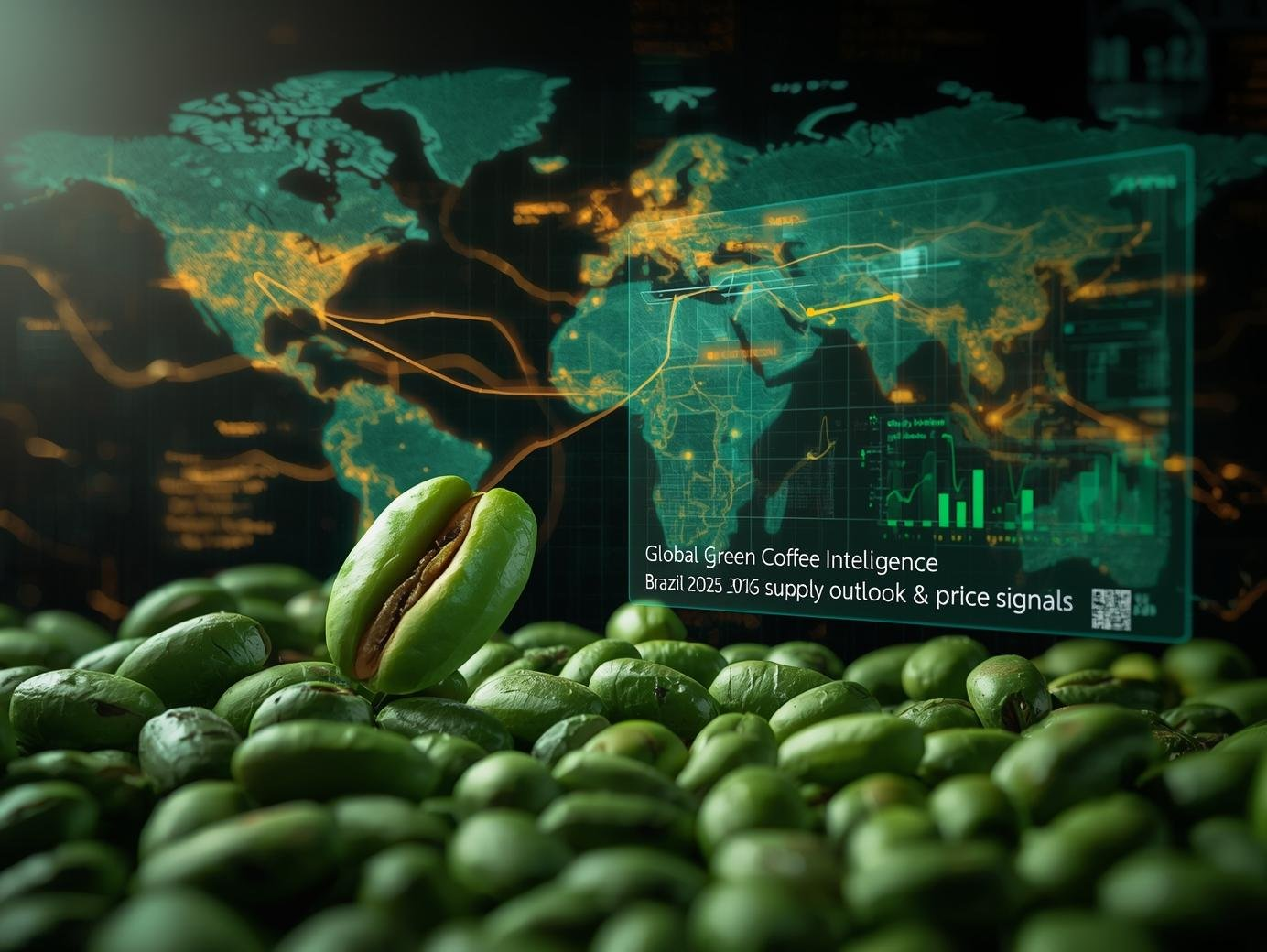
Global coffee markets have shifted into a “re-pricing” phase after Brazil’s official crop outlook signaled higher potential supply in 2026. The result is a more cautious tone in futures and physical buying, especially for Arabica-linked differentials. The key question for importers and roasters is no longer “Will prices fall?” but “How should we buy through volatility?
1) The Market Catalyst: Brazil’s 2026 Crop Outlook
Brazil remains the world’s largest coffee producer, so any official production forecast quickly becomes a global pricing anchor.
Recent official projections from CONAB point to a significantly larger 2026 crop (often interpreted as supply becoming more comfortable compared to the tightness markets feared earlier). This has pressured bullish narratives and encouraged a more balanced (or bearish-to-neutral) view for the near-term price trajectory.
Why this matters:
When buyers believe future supply is improving, they reduce urgency to “chase” prices—especially if nearby availability looks adequate. That shift alone can cap rallies.
2) Price Drivers You Should Watch (Next 30–90 Days)
A) Fund positioning & technical behavior
When markets drop quickly, speculative funds often reduce long exposure or liquidate. After that process, prices can stabilize and trade inside ranges—until a new catalyst appears.
This is why you’ll see sharp intraday swings even when the overall weekly trend looks “flat.”
B) FX impact (USD/BRL)
Brazilian producer selling is strongly linked to currency moves. A stronger BRL can reduce farmer selling (supportive for futures), while a weaker BRL can encourage more selling (pressure on futures).
If you buy physical coffee, this matters because it changes how quickly offers appear in the market and how aggressively producers price.
C) Supply narratives beyond Arabica: Robusta dynamics
The Robusta story is not “only Vietnam.” Brazil’s canephora (Robusta/conilon) has been expanding in importance, and news around canephora expansion into new territory reinforces the idea that global Robusta supply can become structurally more comfortable over time.
In the short run, Robusta still depends on export flow and logistics, but structurally, the market is paying attention to Brazil’s longer-term canephora role.
3) What This Means for Physical Green Coffee Buyers
For importers, roasters, and distributors, the highest risk is not being “wrong” on direction—it’s being undisciplined on timing and tranches during volatility.
Here’s how we recommend thinking about procurement:
Scenario 1 — Base case: Range-bound with high volatility
Futures fluctuate but don’t trend cleanly.
Buyers hesitate; sellers offer selectively.
Best strategy: Buy in tranches (not all at once), especially if you have consistent monthly consumption.
Scenario 2 — Bear case: More pressure as supply confidence grows
Additional bearish headlines (crop, exports, stocks) push prices lower.
Best strategy: Increase tranche frequency (smaller buys more often) and protect cashflow.
Scenario 3 — Bull case: A weather/logistics shock flips sentiment fast
A weather event or logistics disruption can trigger sharp rallies even in a bearish environment.
Best strategy: Keep a minimum coverage floor (don’t run too “short” on inventory) and secure nearby needs first.
4) Practical Buying Playbook (Actionable)
For a shipment quoted CIF to an agreed named port, such as Jebel Ali, confirm the included responsibilities and any onward movement separately. Focus on what you can control:
Define coverage (how many weeks of stock you must hold)
Split purchases into tranches (e.g., 25% + 25% + 25% + 25%)
Separate “nearby” from “forward” buying
Nearby: protect production and sales commitments
Forward: keep flexibility (don’t over-commit at one price point)
Watch differentials as closely as futures
In many cycles, differentials move faster than futures—especially when physical supply is uneven.
5) Our View at MRGT (Positioning)
Given the current sentiment shift, we consider the market bearish-to-neutral in the near term unless a fresh supply disruption appears. At the same time, volatility remains elevated, meaning short rallies can happen quickly.
For buyers, the most professional approach right now is not prediction—it is structured buying.
Reuters: Brazil’s canephora expansion (12 February 2026)
Reuters: DSV, freight rates and Red Sea routes (4 February 2026)
Reuters: Maersk results and freight-rate outlook (5 February 2026)
For buyers in the UAE and the GCC: see how MRGT works as a green coffee supplier in the UAE, from UAE stock or shipped from origin.
A crop forecast is not a lot-availability confirmation
Read a crop forecast with its publication date, crop year and species coverage in view. Conab's February 2026 assessment is one dated estimate in a continuing survey series; later assessments should not be silently substituted into this article's original scenario. For a buyer, national production context and the readiness of a specific shipment answer different questions.
When discussing Brazilian coffee with MRGT, identify the required species, preparation and intended use, then ask which lot can be proposed for one 20-foot container or more. Confirm UAE availability for that lot, or discuss direct shipment from origin to your destination. Bag weight, loading plan, route and timing are confirmed for the particular order. Use the original forecast as historical context while basing an operational decision on the coffee specification and a current shipment discussion.
Request a container shipment plan · Compare Brazilian coffee with other listed origins
Send this market note to a buyer or colleague.